The heritage behind the house
Asanteman — A Living Heritage
GYƐ is Ghanaian, with a particular cultural inheritance from the Asante people of central Ghana. This page is not a claim to represent every Ghanaian tradition. It is an introduction to the histories, materials, institutions and ideas that form part of the world from which the house grows.
We use Asante throughout this page (also written “Ashanti” in older English and colonial spelling).
Place
Where We Come From
Schematic diagram of relationships, not a map to scale. Kumasi has been the political and cultural center of Asante for centuries. Bonwire is an important center of Asante Kente weaving. Accra is Ghana's national capital.
Ghana is culturally diverse. The Asante are one people within the larger Akan family, and Ghana also includes peoples identified in Ghana Statistical Service classifications:
- Akan
- Ewe
- Ga-Dangme
- Guan
- Mole-Dagbani
- Gurma
- Grusi
- Mande
- and many others
GYƐ is rooted particularly in Asante heritage; it does not present Asante culture as the entirety of Ghana.
Formation
A Kingdom Built Around Kumasi
Around the end of the seventeenth century and the beginning of the eighteenth, Osei Tutu and Okomfo Anokye helped unite Akan chiefdoms around Kumasi into the Asante state. What emerged was not only a military power but an administrative and ceremonial order, with offices, courts, oaths and regalia.
Where the economy of historic Asante is discussed, it should be discussed honestly: Asante wealth involved gold, agriculture and regional trade, and it also participated in systems of slavery and the Atlantic slave trade.
The Golden Stool
The Golden Stool — Sika Dwa Kofi — is not simply a throne. Within Asante tradition it embodies the collective soul of the nation. Even the Asantehene does not sit upon it.
We do not reproduce the Golden Stool as decoration, pattern or fashion prop, and we do not illustrate it with invented imagery. Photographs appear here only where a museum or palace collection permits their use in context.
Chronology
A Short Asante Timeline
Dates are given as a study aid, not as a complete history. This chronology includes conflict, exile and colonization; none of it is presented as romance.
c. late 1600s–1700
The consolidation of Asante power around Kumasi under Osei Tutu and Okomfo Anokye.
Entry 1 of 1018th–early 19th centuries
Asante develops into one of the most powerful states in West Africa, supported by political organization, military power, regional commerce, agriculture and the gold trade.
Entry 2 of 101874
A British military expedition invades Kumasi and destroys part of the city. Significant royal objects are taken during the Anglo-Asante conflicts.
Entry 3 of 101896
Asantehene Prempeh I is deposed and exiled with members of the Asante leadership.
Entry 4 of 101900
Yaa Asantewaa, Queen Mother of Ejisu, becomes the great symbol of resistance during the conflict remembered as the War of the Golden Stool.
Entry 5 of 101902
Asante territory is incorporated into the British Gold Coast colony.
Entry 6 of 101924
Prempeh I returns from exile.
Entry 7 of 101935
The office of Asantehene is formally restored under Prempeh II.
Entry 8 of 106 March 1957
Ghana becomes independent.
Entry 9 of 101999–present
Otumfuo Osei Tutu II serves as Asantehene, within a traditional institution that continues alongside the modern Republic of Ghana.
Entry 10 of 10
Lineage
Lineage Through the Mother
Akan society is traditionally matrilineal: lineage membership and important forms of inheritance and succession are traced through the mother's line.
Queen mothers are not decorative “queens.” Within Akan governance they have historically held political and social authority, including roles in the selection and counsel of chiefs.
Yaa Asantewaa was Queen Mother of Ejisu and the leader of the 1900 resistance remembered as the War of the Golden Stool. She belongs to political history, not to costume: a figure of office, strategy and consequence.
On representation
GYƐ does not generate imagined portraits of historical figures. Where a photograph of Yaa Asantewaa or Asante leadership is shown, it must come from a reputable collection with its credit line intact — person, approximate date, collection and image credit.
Material
Gold, Authority & Meaning
Gold was central to Asante economic power, court life, diplomacy, spirituality and visual culture — regalia, rings, pendants, court objects and state swords.
Weighing value
Akan merchants developed brass weights for measuring gold dust. These weights grew into an extraordinary visual language incorporating geometry, animals, objects and proverbs — small objects carrying large ideas.
Scholars have noted connections between some early geometric forms and long-distance trade with Muslim North Africa.
Continue in Faith & Form →Object gallery in preparation. Gold regalia, rings, pendants, court objects, state swords and brass gold weights will be shown here only from properly licensed museum photography, each with object, approximate date, maker or culture, collection and image credit. Where an object was removed during colonial warfare, that provenance will be stated rather than erased.
Cloth
Cloth Built Strip by Strip
Kente is central to GYƐ, so it deserves accuracy rather than atmosphere.
- Asante Kente is traditionally narrow-strip woven.
- Individual strips are woven first, then joined edge-to-edge into a larger cloth.
- Silk and cotton Kente became important markers of rank and prestige in Asante society.
- Certain historical designs were associated with rulers, courts or particular contexts.
- Bonwire is historically important to the Asante weaving tradition.
- Modern Kente exists in many materials, qualities, colors and contexts.
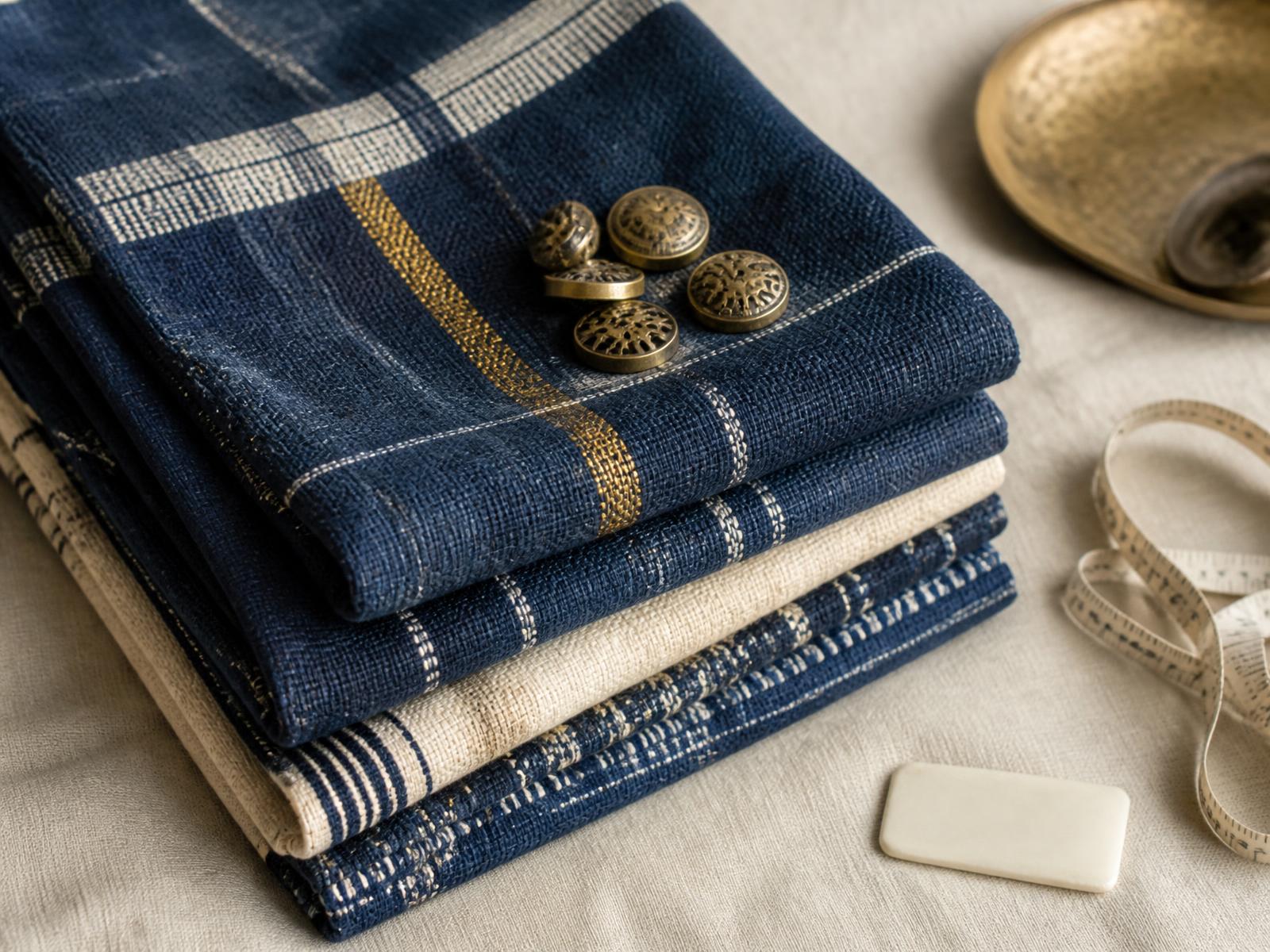
- We do not publish universal colour-meaning charts. Historic Asante textile aesthetics were broader than today's familiar palette — museum collections also hold refined blue-and-white Asante cloth. Meaning is specific to a cloth, a maker and a context.
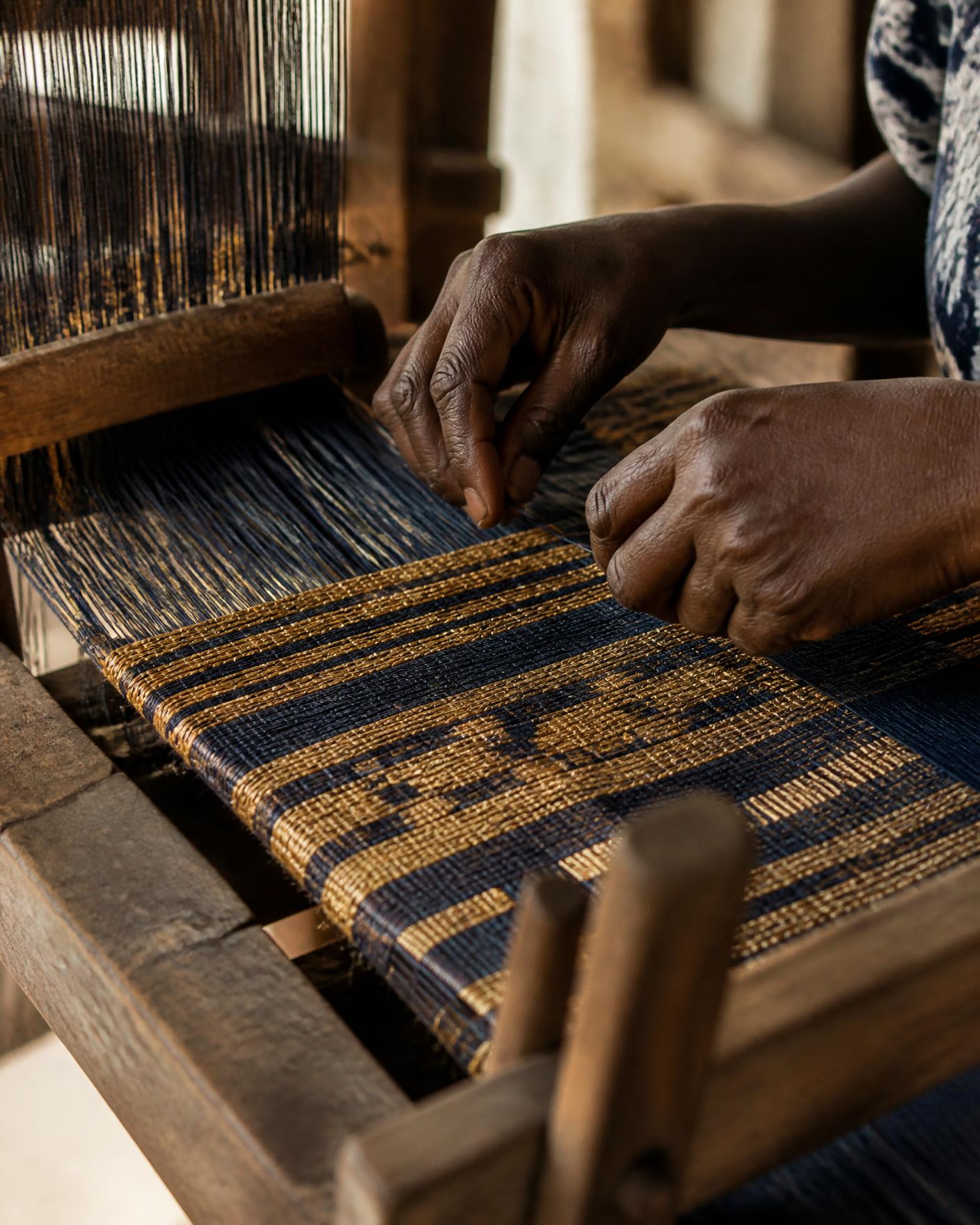
Contemporary weaving photography · GYƐ development reference
01
Thread
Cotton or silk, dyed and warped
02
Narrow strip
Woven on a horizontal treadle loom
03
Joined strips
Sewn edge-to-edge by hand
04
Full cloth
A single composed textile
05
Garment
Draped, cut or constructed
Symbol
Ideas Made Visible
Adinkra is a visual system associated particularly with Akan and Asante culture, appearing historically on cloth as well as on objects. Many symbols communicate concepts, maxims and proverbial ideas.
Gye Nyame
Widely documented as expressing the supremacy of God. One of the most frequently reproduced Akan symbols.
Source: Smithsonian National Museum of African Art; The Metropolitan Museum of Art
Sankofa
Associated with the idea of returning to retrieve what is of value from the past — commonly rendered in the stylised form of a bird turning its head backwards.
Source: Smithsonian National Museum of African Art
Adinkrahene
Concentric circles described as the 'chief' of the Adinkra symbols, associated with leadership and greatness.
Source: Museum documentation of Adinkra stamped cloth
Nyame Dua
A form associated with an altar or place of worship, referring to the presence and protection of God.
Source: Museum documentation of Akan visual culture
GYƐ studies these visual traditions. It does not stamp an Adinkra symbol onto a garment to make it read as “Ghanaian.” Culture also lives through form, proportion, craft and material.
Architecture
Built Meaning
The UNESCO-listed Asante Traditional Buildings survive near Kumasi as the last material witnesses of a great civilisation's architecture.
Surviving traditional buildings use materials including timber, bamboo and mud plaster, historically with thatched roofs. Their decorative bas-reliefs carry symbolic designs involving animals, plants, spirals and forms associated with Asante ideas and beliefs — decoration that thinks.
This website borrows quietly from that vocabulary: courtyard composition, earthen texture, relief and shadow. It does not convert sacred architecture into a repeating “African pattern.”
Reference: UNESCO World Heritage Centre, Asante Traditional Buildings
Schematic only. The inscribed sites lie in villages north-east of Kumasi.
Language
A Culture That Speaks in Layers
Asante Twi is a language of proverb, metaphor, naming and symbolic speech — and that habit of layered meaning runs straight into the visual arts.
Gold weights
Small brass objects that quote proverbs in geometry and form.
Adinkra
Graphic marks standing in for maxims and ideas.
Court arts
Regalia, swords and staffs that speak in emblem and gesture.
Named textiles
Cloths carrying names, sayings and associations.
GYƐ will not fill this site with invented Twi. Any Twi phrase published here is verified first.
Heritage is not a closed chapter.
Asante culture did not end with empire, colonialism or independence. The language is spoken. The institutions continue. Cloth is woven. Ceremonies are held. Artists work. Families inherit. Makers experiment. A living culture changes because living people continue to make it.
GYƐ enters that story as a student first, and a designer second.
Our Mission
Sources & further reading
GYƐ is a clothing house, not an academic authority. This page paraphrases and credits published institutional scholarship, and will be corrected where we get something wrong.
- Manhyia Palace Museum, Kumasi — Asante royal and institutional history
- UNESCO World Heritage Centre — Asante Traditional Buildings
- Ghana Museums and Monuments Board — national collections and monuments
- Ghana Statistical Service — Ghana's ethnic and linguistic diversity
- The Metropolitan Museum of Art — Kente, Akan gold weights and metalwork
- Smithsonian National Museum of African Art — Adinkra, Asante textiles and prestige objects
- Cambridge University Press scholarship — Muslim communities and zongos in Asante